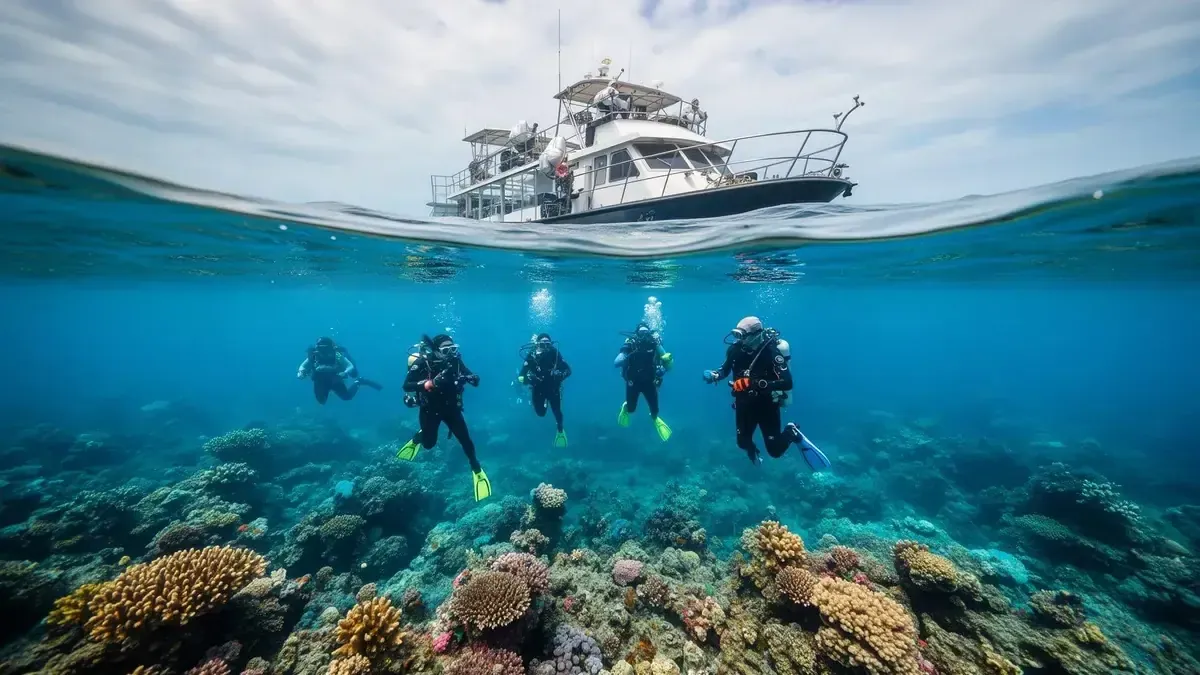
Dive Charter
Purpose-Built Expeditions to
Extraordinary Reefs.
Luxury liveaboard experiences with world-class diving access — purpose-equipped vessels navigating remote reef systems and marine reserves.
The Opportunity
A Premium Niche With Unmatched Client Loyalty.
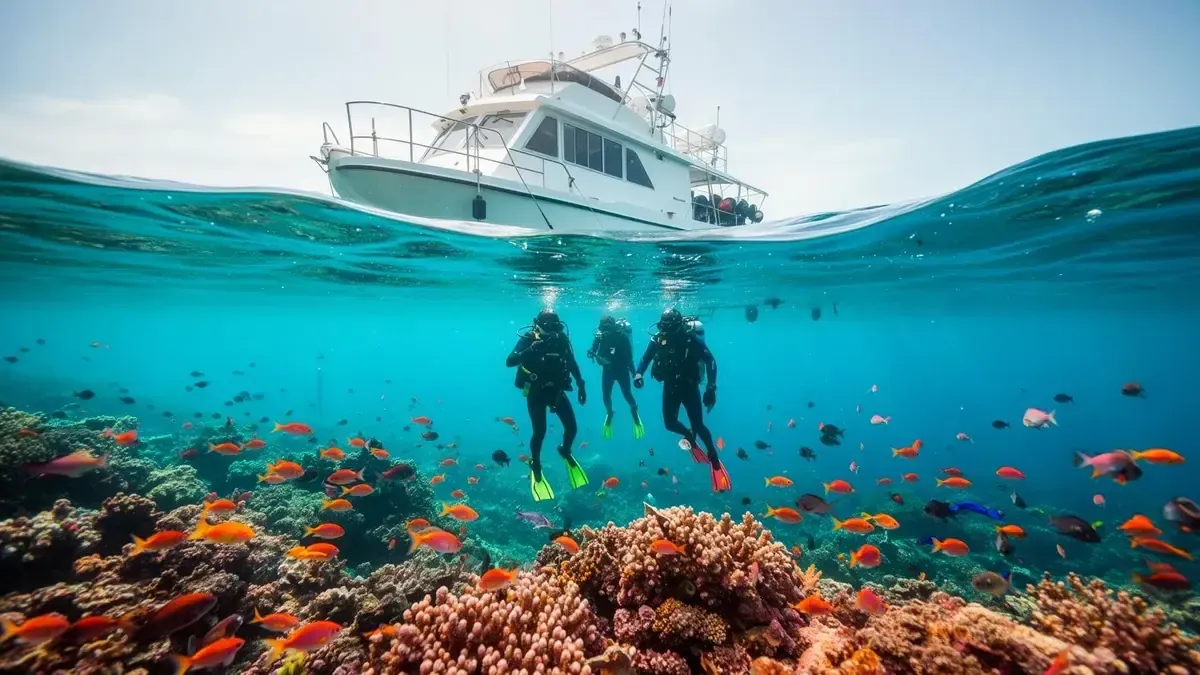
Dive charters combine luxury liveaboard experiences with world-class diving access — compressors, dive decks, and expert guides navigating some of the planet's most remote and pristine underwater ecosystems.
Dive charter clients return at 3× the rate of general charter guests. Enquire →
Revenue Benchmarks
Typical Dive Charter Economics
Industry-standard rate ranges for liveaboard dive operations across key markets.
Per-Person/Night
$250–$800
Varies by region & vessel class
Full-Boat Weekly
$15,000–$60,000
8–20 guest capacity liveaboards
Peak Season Premium
+25–45%
Whale shark, manta & spawning seasons
Annual Utilisation
30–42 weeks
Year-round in tropical markets
Ancillary Revenue
15–25%
Equipment, courses, Nitrox, photos
Operating Margin
30–45%
After crew, fuel & dive operations
What's Different About Dive Charter
Purpose-Built Vessels, Certified Guest Requirements, & Compressor Economics.
Onboard Compressors, Nitrox Membrane & Tank Rooms
A dive liveaboard is not a leisure yacht with dive gear stored aft — it's a purpose-built vessel with dedicated compressor rooms (typically 2× Bauer or Coltri high-pressure units for redundancy), Nitrox membrane systems for enriched-air fills, tank storage racks for 60–120 cylinders, dive-deck plumbing, and often a rebreather-support workshop. Capital cost per berth is 30–50% higher than an equivalent-length leisure yacht.
Certified Divers Only — a Bounded Client Pool
PADI Open Water or equivalent is the minimum entry bar; most premium liveaboard itineraries require Advanced Open Water, 30–50 logged dives, or wreck/deep specialties. The addressable client pool is finite (~28 million active certified divers globally, ~3 million active liveaboard-eligible), which changes marketing entirely — you fish in a certified pond via dive-community channels, not broad luxury media.
Remote Reef Access Is the Product, Not the Vessel
Clients book destinations, not hulls: Red Sea Brothers/Daedalus/Elphinstone, Maldives Central/Northern Atolls, Raja Ampat, Galápagos, Cocos Island, Socorro. Vessel comfort matters, but itinerary access rights — including national-park permits, marine-reserve concessions, and hyperbaric-chamber proximity — are what actually differentiate a saleable dive charter.
7–14 Night Fixed-Itinerary Format
Unlike Med charter's flexible daily itinerary, dive liveaboards run fixed departure schedules — Saturday-to-Saturday or 10-night itineraries pre-published a year in advance. This is more analogous to a small-ship cruise line than to a yacht charter: revenue management, cabin allocation, wait-lists, and cancellation policy structure all follow cruise-industry logic.
Ancillary Revenue Structurally Higher
Dive charter earns 15–25% of gross revenue in ancillaries — Nitrox fills (€8–12 per tank), rental gear (€25–45/day), specialty courses (€300–€600), rebreather support fees, underwater photography services, and dive insurance. This margin layer is much larger than the F&B upsell available to conventional charter and is baked into the operating model, not opportunistic.
Regulatory & Safety Stack Is Marine + Diving
Operators must comply with maritime passenger-vessel regulations (SOLAS or national equivalent) AND dive-industry safety standards (PADI IDC, DAN insurance, recompression chamber protocols, oxygen supply logs, dive-guide-to-diver ratios). Insurance premiums are meaningfully higher due to compressed-gas storage and diving-incident exposure — realistic P&I premiums run 2–3× a leisure-charter equivalent hull.
Dive Charter FAQ
Which dive-charter markets have the highest year-round utilisation?
Red Sea (Egypt) runs 42–46 weeks a year with only a brief summer heat window; Maldives operates 48–50 weeks with a monsoon-driven itinerary switch between Northern/Central atolls (Dec–Apr) and Southern atolls (May–Nov); Raja Ampat runs 34–38 weeks (Oct–Apr peak); Galápagos and Socorro run 32–36 weeks. Utilisation ceilings above 40 weeks are entirely feasible in the tropics — dive charter is one of the few charter segments without a hard shoulder-season gap.
How does dive-charter repeat rate compare to general charter?
Best-in-class dive liveaboard operators report repeat-guest rates of 45–65%, materially higher than the 15–25% typical of Med crewed charter. Two drivers: the dive community is small and tightly networked (a satisfied guest tells 10 divers, all of whom will consider booking within 24 months), and repeat visitation to progressive sites (Red Sea → Maldives → Raja Ampat → Galápagos as a lifetime pipeline) is a natural client journey.
What certifications and equipment must the operator provide?
At minimum: PADI 5* IDC (or equivalent SSI/RAID) affiliation, at least one PADI IDC Staff Instructor onboard, DAN-Europe/DAN-World professional membership and insurance, functioning O2 emergency kit with a minimum 4-hour supply, a working AED, verified dive-guide-to-diver ratios (typically 1:4 or 1:6), documented dive-briefing logs, a defined lost-diver protocol, and emergency communications with the nearest recompression chamber. Nitrox fills require compressor certification and CO analysis on every fill.
Where does dive-charter revenue leakage typically happen?
Three places consistently. (1) Underbuilt ancillary rate cards — many operators still bundle Nitrox, cameras, and rental gear rather than charging line items; recapturing this alone is a 12–18% revenue lift. (2) Wait-list and cancellation policy — dive charters overbook cabins the way airlines overbook seats, but many operators lack the discipline; a proper wait-list plus 60-day non-refundable structure recovers 6–10% of gross. (3) Repeat-guest CRM — dive clients rebook if invited to the next progression itinerary within 90 days of returning home; most operators never make the ask systematically.
Explore Other Verticals
Revenue Architecture Across Every Niche
Bareboat Charter
Self-skippered freedom across the Med & Caribbean.
View vertical →Catamaran Charter
Twin-hull stability & the fastest-growing segment.
View vertical →Gulet Charter
Heritage craftsmanship on the Turquoise Coast.
View vertical →Day Charter
High-frequency, high-margin volume opportunity.
View vertical →Corporate & Events
Superyachts as exclusive floating venues.
View vertical →Engineer Predictable Dive Charter Revenue
From expedition marketing to repeat-client infrastructure — we build the system.
Request Strategic Audit