Gulet Charter
Timeless Craftsmanship Meets
the Turquoise Coast.
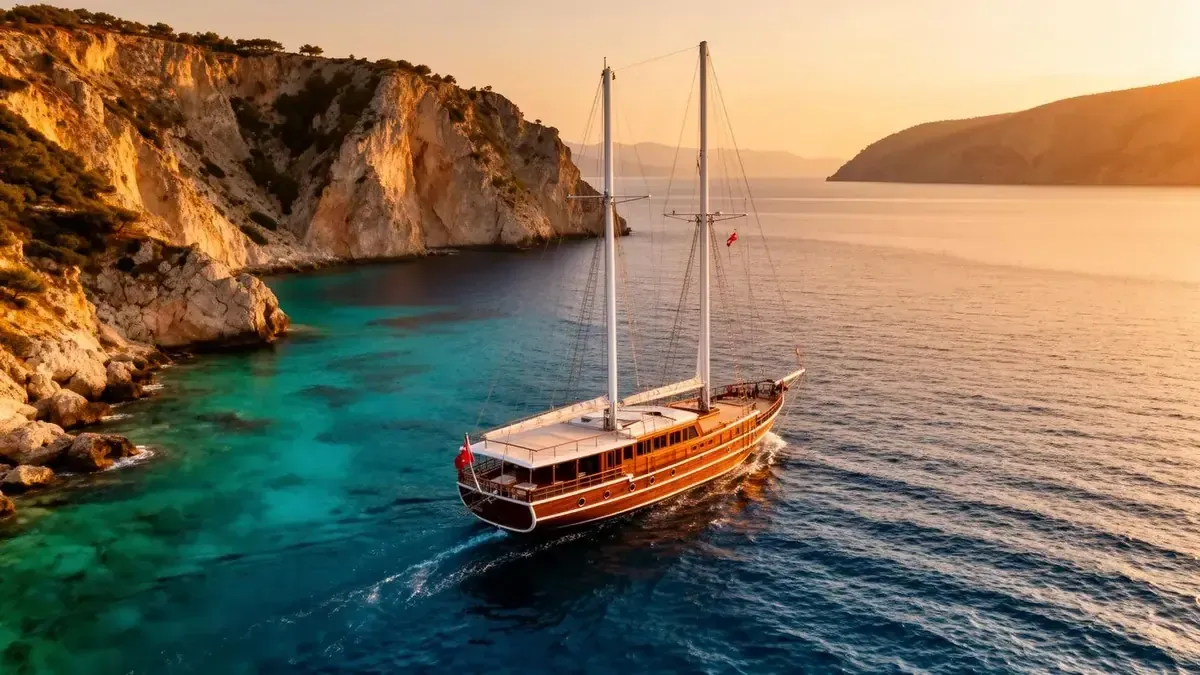
Traditional hand-built wooden motorsailers offering an intimate, boutique charter experience defined by craftsmanship, warmth, and exploration.
Market Overview
The Authentic Alternative to Modern Luxury.
600+
Gulets operating commercially in Turkey
€2.5K–€12K
Daily rate range
70%
Repeat & referral bookings
24m–40m
Typical vessel length
A segment where heritage commands premium pricing. Enquire →
Revenue Benchmarks
Typical Gulet Charter Economics
Industry-standard rate ranges for gulet operations across the Turkish & Greek coasts.
Daily Rate
€2,500–€12,000
Varies by vessel size & season
Weekly Rate
€15,000–€80,000
Standard 7-night Turkish coast itinerary
Peak Season Premium
+40–70%
June–September on Turquoise Coast
Annual Utilisation
16–24 weeks
May–October primary season
Gross Yield per Vessel
€180K–€800K
Annual revenue before operating costs
Operating Margin
25–40%
After crew, maintenance & harbour fees
What's Different About Gulet Charter
A Distinct Vessel Class, Market, & Commercial Model.
Hand-Built Wooden Motorsailers, Not Production Yachts
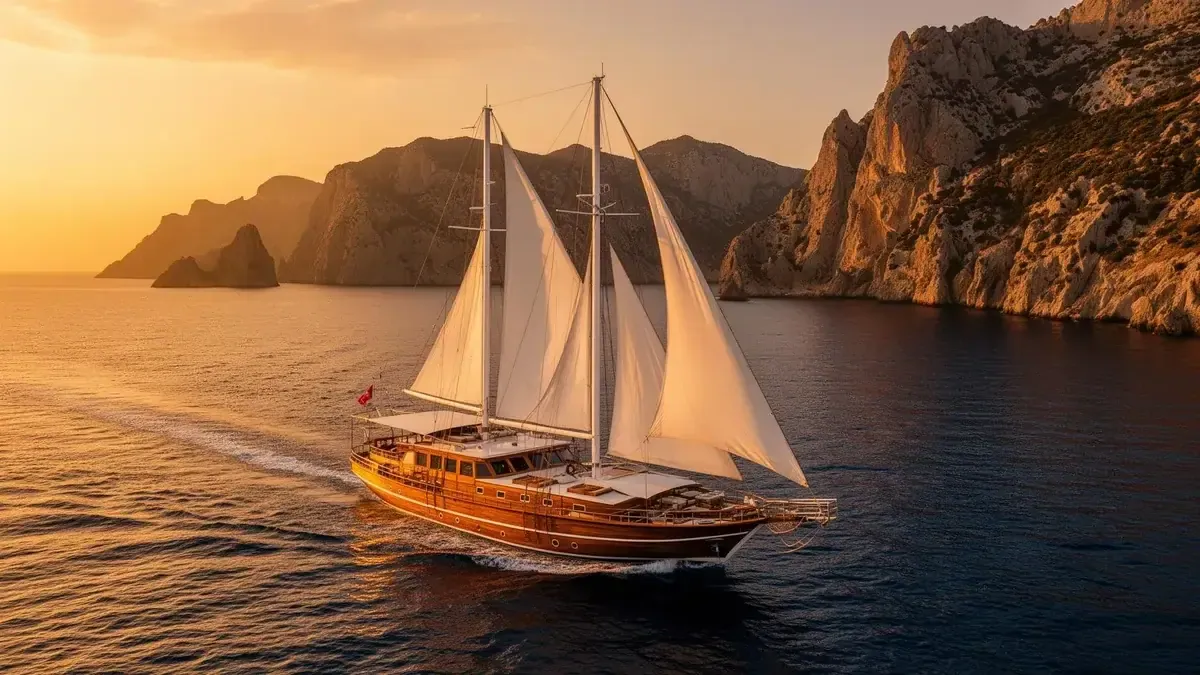
Every commercial gulet is an individually built vessel from the shipyards of Bodrum, Marmaris, or İçmeler — typically 24–40m LOA, iroko or mahogany on oak frames, with a broad beam optimised for on-deck living. There is no series production, no bareboat inventory, and no builder brand-equity comparison to Benetti or Sanlorenzo. Positioning is craftsmanship-per-hull, not manufacturer marque.
All-Inclusive Pricing Is the Norm
Roughly 80% of gulet charters price on an all-inclusive basis — fuel, harbour fees, three meals a day, soft drinks, and often wine and beer are bundled into the weekly rate. This is the opposite of the Med superyacht APA model (25–35% top-up on charter fee). It simplifies the sale for the client and requires very different provisioning economics from the operator.
The Turkish Blue Cruise Circuit Is Geographically Fixed
Almost all gulet demand runs one of four routes: Bodrum–Gökova Gulf, Fethiye–Göcek 12 Islands, Fethiye–Kekova (Lycian coast), and Marmaris–Datça–Greek Dodecanese. These itineraries are 7-night, port-anchor-port sequences with limited flexibility — which structures booking behaviour, crew training, and provisioning around a known repertoire.
Higher Guest Capacity Than Equivalent-Length Yachts
A 30m gulet routinely accommodates 12–14 guests in 6–7 cabins with private heads — a load-out impossible on a same-length modern motor yacht. This drops per-guest weekly cost dramatically (typically €800–€1,800 per person per week all-in) and opens the market to family and multi-couple bookings priced out of monohull crewed charter.
Turkish Flag & Cabotage Rules
Commercial gulets fly the Turkish flag under a Turizm Yat (tourist yacht) licence, with cabotage rules that historically restrict foreign-flag vessels from picking up passengers in Turkey. Charters into Greek waters require dual clearance and a T2L (or per-charter Greek clearance) — a routine but rigid process most operators pre-book at the start of the season.
70% Repeat & Referral Rate
The gulet segment sees the highest client-loyalty metrics in Med charter — typically 70% of any established operator's bookings come from repeat clients or their referrals. Client acquisition, once made, has extraordinary lifetime value; the CAC-to-LTV maths rewards heavy investment in guest experience over rapid new-lead volume.
Gulet Charter FAQ
How does gulet pricing actually work compared to Med superyacht?
Gulets almost universally price all-inclusive — weekly rate covers fuel, three meals daily, soft drinks (often wine and beer), and harbour fees. A 30m gulet at €35,000/week for 12 guests is a fully landed cost. A comparable-guest Med superyacht at €150K/week charter fee typically adds 30% APA plus 18% Turkish or 20% French VAT, landing around €215K — 6× more per week for a similar guest experience with more polished service but far less on-deck living space.
What is the operating margin on a well-run gulet business?
Established Turkish-based operators run 25–40% net margins on €180K–€800K annual gross per vessel. Cost structure differs from monohulls: crew costs are lower (Turkish crew wages), but fuel and provisioning are baked into the weekly rate as operator cost, harbour fees are heavier due to the med-mooring / anchoring pattern, and hull maintenance requires shipwright-grade wooden-hull knowledge — a scarce and increasingly expensive skill.
Can gulets legally charter in Greece as well as Turkey?
Yes, but the paperwork is deliberate. Turkish-flag commercial gulets can pick up passengers in Turkey and cruise into Greek waters with a per-charter clearance (or seasonal T2L equivalent) obtained via a Greek agent, plus a Greek Cruising Tax (TEPAI) payment. What they cannot legally do is embark passengers in a Greek port — that requires a Greek-flag vessel or a Greek charter licence. This is why the Fethiye–Rhodes and Marmaris–Symi crossings are structured with pickup and drop-off both in Turkey.
Where is gulet demand growing fastest?
The Turquoise Coast core market (Turkish clients, German, Austrian, Dutch, UK) is steady. The material growth is US and Australian demand, which has roughly doubled since 2020, and Brazilian and GCC UHNW demand for private-family bookings on premium 35m+ deluxe gulets. Charters targeting these segments increasingly bundle bespoke provisioning (private chef, sommelier), yoga-instructor add-ons, and photographer inclusion — pushing weekly rates on top-tier gulets into the €80K–€120K range.
Explore Other Verticals
Revenue Architecture Across Every Niche
Bareboat Charter
Self-skippered freedom across the Med & Caribbean.
View vertical →Catamaran Charter
Twin-hull stability & the fastest-growing segment.
View vertical →Dive Charter
Purpose-built liveaboard expeditions to remote reefs.
View vertical →Day Charter
High-frequency, high-margin volume opportunity.
View vertical →Corporate & Events
Superyachts as exclusive floating venues.
View vertical →Scale Your Gulet Charter Operations
From heritage positioning to yield optimisation — we architect the revenue system.
Request Strategic Audit