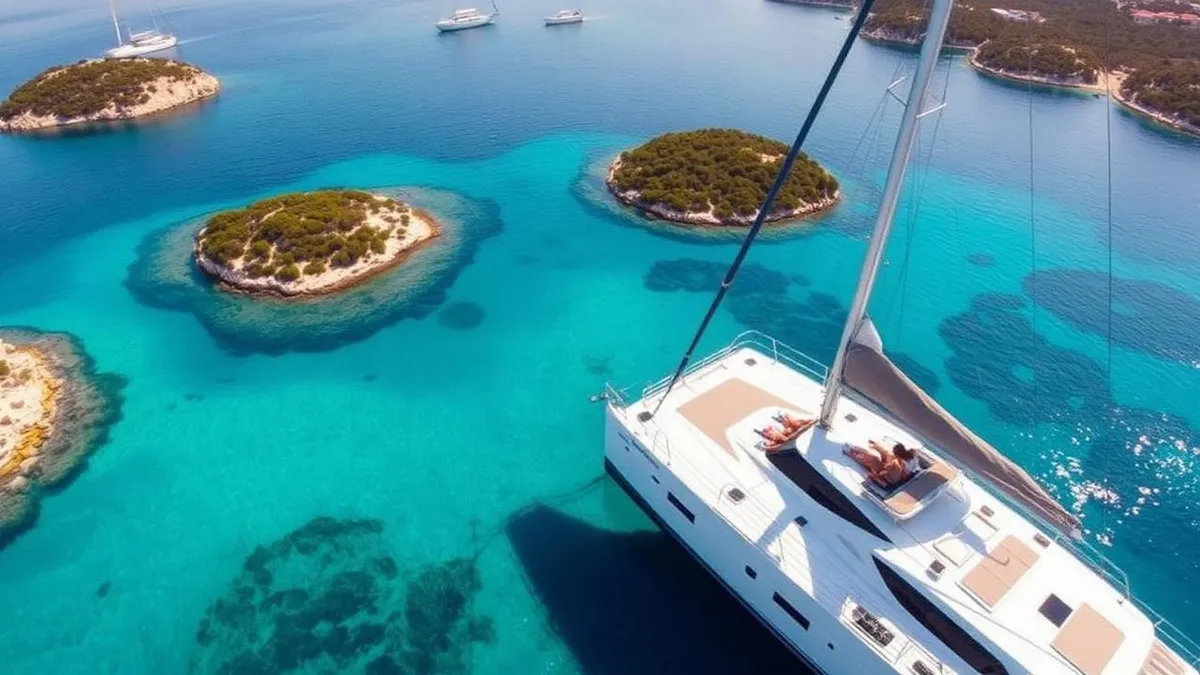
Catamaran charters are the fastest-growing segment in the global charter market, with bookings increasing 22% year-over-year. Driven by younger affluent travellers, family groups, and operators seeking higher margins through lower operating costs, the multi-hull revolution is reshaping fleet investment strategies across the Mediterranean and Caribbean.
Why Catamarans Are Winning Market Share
The catamaran's commercial advantages are structural, not cyclical. A 50-foot catamaran offers 50% more usable living space than a monohull of equivalent length, draws less than a metre of water (enabling access to shallow anchorages inaccessible to motor yachts), and consumes 30–40% less fuel at cruising speeds. For charter guests, this translates to more space, more destinations, and more comfort. For operators, it means higher margins.
The stability factor cannot be overstated. Catamarans virtually eliminate the rolling and heeling that causes seasickness — a significant barrier to first-time charter guests. In markets like Croatia, where 35% of all charters are now catamarans (versus 18% globally), the format has demonstrably expanded the total addressable market by attracting guests who would never consider a traditional sailing yacht.
Market Data: The Growth Story
Global catamaran charter bookings grew from 14% of total charter activity in 2020 to 23% in 2025. The acceleration is driven by three factors: new-build supply (Lagoon, Fountaine Pajot, and Leopard have expanded production capacity by 35%), changing guest demographics (millennials and Gen X represent 62% of catamaran bookers versus 41% for motor yachts), and destination expansion in markets where catamarans' shallow draft creates competitive advantage.
Revenue per available day for catamarans has increased 18% over the past three years — outpacing both motor yachts (12%) and sailing yachts (8%). This reflects both rate increases and improved utilisation: catamarans achieve an average of 22 charter weeks per season versus 16 for motor yachts, driven by lower operating costs that enable competitive pricing in shoulder seasons.
Revenue Benchmarks by Market
Croatia / Adriatic
€8,000–€25,000/week
Growth: +28% YoY
Greece / Cyclades
€10,000–€30,000/week
Growth: +24% YoY
BVI / Caribbean
€12,000–€35,000/week
Growth: +19% YoY
French Riviera
€15,000–€45,000/week
Growth: +15% YoY
The Luxury Catamaran Segment
The most significant development is the emergence of luxury power catamarans — 60 to 80-foot vessels with interiors and service levels comparable to motor yachts, but with the stability and efficiency advantages of multi-hull design. Builders like Sunreef, Silent Yachts, and ILIAD are producing vessels that command weekly rates of €30,000–€80,000, blurring the line between catamaran and superyacht segments.
Silent Yachts' solar-electric catamarans represent the intersection of two growth trends: catamaran charter demand and sustainable yachting. These vessels operate with zero fuel costs during normal cruising, creating margin structures that traditional motor yachts simply cannot match.
Operational Advantages for Charter Operators
Lower Crew Requirements
A 50-foot charter catamaran can operate with a crew of 2–3 (captain and hostess/chef), versus 4–6 for a motor yacht of comparable guest capacity. Crew costs represent 25–35% of operating expenses, so this efficiency directly improves margins. For operators managing multiple vessels, the crew cost differential across a fleet of 5–10 catamarans creates substantial annual savings.
Maintenance and Berth Costs
Catamaran haul-out and maintenance costs are 20–30% lower than motor yachts of equivalent length. Marina berth rates, typically calculated by length, are comparable — but the usable space per berthing dollar is significantly higher. Some operators choose anchor-based operations with tender service, eliminating berth costs entirely during the charter season and passing the savings into competitive pricing.
Fleet Investment Strategy
For operators considering fleet expansion, the catamaran business case is compelling. A new 50-foot sailing catamaran (€800,000–€1.2 million) generates annual charter revenue of €120,000–€200,000 with operating costs of €40,000–€70,000. This translates to a 10–15% return on investment — superior to most motor yacht alternatives and with lower capital risk. Many owners offset costs further through charter management programmes.
The depreciation profile is also favourable: quality catamarans from tier-1 builders retain 70–80% of their value after five years of charter use, versus 55–65% for motor yachts. This residual value protection reduces the effective cost of fleet ownership and provides exit flexibility. Maximising returns requires disciplined fleet utilisation strategies.
Dynamic pricing is equally important for catamaran operations. While per-day rates are lower than motor yachts, the higher utilisation rates mean that optimising pricing across 22+ weeks of charter activity has a proportionally larger impact on total season revenue.
Where the Market Is Heading
Catamaran charter demand shows no signs of slowing. The segment is projected to reach 30% of global charter activity by 2028, driven by continued new-build delivery, destination expansion, and demographic shifts. For operators and investors, the window to establish positioning in the highest-growth Mediterranean markets is narrowing. The operators who build catamaran-focused brands now will capture disproportionate share as the market matures.
Explore our catamaran charter strategy
View Catamaran Charter Services →Put this on autopilot. Our yacht marketing platform publishes your fleet across 11 channels, captures every inquiry and reports revenue per vessel. See how the engine works →